
You are using an out of date browser. It may not display this or other websites correctly.
You should upgrade or use an alternative browser.
You should upgrade or use an alternative browser.
Alex’s IM 150 EXT
- Thread starter Alexander1312
- Start date


@Thales where's the Reef Beef affiliate code? LolBased on this thread, I just bought a vee gee as well.

hahah@Thales where's the Reef Beef affiliate code? Lol

Alexander1312
Supporting Member
Same. And you know what, I think the Milwaukee is pretty accurate after all, and probably provides the best balance of convenience and accuracy amongst all of them.Maaaaaannnn because of all the hype around here with the Tropic Marin hydrometer last year, I bought one, thinking maybe my Milwaukee digital refractometer was off and the cause of my recent woes. Now I gotta get a veegee??
I re-read the ATC (auto temp compensation) instructions for the Milwaukee again, since I am having issues with the Veegee despite the calibration - possibly related to ATC (which the Veegee has to) - will probably start a different thread with this.
The instructions say you should wait for up to minute if the temp differs significantly. I waited longer in the past, which was wrong (increased salinity), same as taking the immediate reading (often lower than actual salinity). And it could probably make sense to wait only around 30 seconds, not a minute, to lock in the salinity read by the Milwaukee, and probably the Veegee too since ambient and device temp are not too different and the amount is small.
When I do this, both actually show the same results, and I must say I found the Milwaukee more convenient than the Veegee.
Last edited:
Alexander1312
Supporting Member
Thank you. And yes, its ok for it to need calibration out of the box, my expectations were a bit too high I guess. But I still struggle with the consistency of the readings, but will start a different thread for experience sharing.Also picked up the Veegee - mine clearly needed calibration out of the box. Not to pile on, but my experience with it so far is good.
Tank looks great!
Alexander1312
Supporting Member
My quick take on Key Water Parameter Management [I will update this as per new insight]:

Alexander1312
Supporting Member
I am cleaning the AVAST auto feeder pump every 16 weeks at the moment.
It looks like this is not frequent enough. The smell was terrible, and I assume this is a potential source for my higher phosphates despite regular GFO usage.
Also, I believe someone suggested to not run the pump 24/7 - which I adopted [30 minutes - 3 times a day] - and I guess this further contributed to this issue, as it was never looking and smelling as terrible as this when I ran the pump 24/7 previously.


It looks like this is not frequent enough. The smell was terrible, and I assume this is a potential source for my higher phosphates despite regular GFO usage.
Also, I believe someone suggested to not run the pump 24/7 - which I adopted [30 minutes - 3 times a day] - and I guess this further contributed to this issue, as it was never looking and smelling as terrible as this when I ran the pump 24/7 previously.

Kensington Reefer
Supporting Member
Yummy!
I run mine 24/7 and it stays pretty clean. Do you have the cannonball?I am cleaning the AVAST auto feeder pump every 16 weeks at the moment.
It looks like this is not frequent enough. The smell was terrible, and I assume this is a potential source for my higher phosphates despite regular GFO usage.
Also, I believe someone suggested to not run the pump 24/7 - which I adopted [30 minutes - 3 times a day] - and I guess this further contributed to this issue, as it was never looking and smelling as terrible as this when I ran the pump 24/7 previously.
View attachment 78651View attachment 78652
Alexander1312
Supporting Member
Yes, I do.I run mine 24/7 and it stays pretty clean. Do you have the cannonball?
Alexander1312
Supporting Member
Potassium chloride to dip corals on rocks
I have a few corals on individually removable rocks and I do not want to remove them from the rocks for dipping. While I typically use the FM dip for all things dipping, I am not sure if whole rocks should be dipped in it.
I got the Potassium Chloride from Will at the last swap, and thought given what this is, it should not be a problem to dip the mounted coral with rock into it.
It seems like two teaspoons should be added to one gallon as per the reef bums instructions [https://www.reefbum.com/pests/another-option-for-an-aefw-dip/]
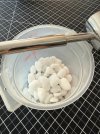
Main challenge is now to get this rock hard potassium chloride pieces into a solution, since they seem to not easily dissolve [everything in this hobby gives you a curveball].
I have a few corals on individually removable rocks and I do not want to remove them from the rocks for dipping. While I typically use the FM dip for all things dipping, I am not sure if whole rocks should be dipped in it.
I got the Potassium Chloride from Will at the last swap, and thought given what this is, it should not be a problem to dip the mounted coral with rock into it.
It seems like two teaspoons should be added to one gallon as per the reef bums instructions [https://www.reefbum.com/pests/another-option-for-an-aefw-dip/]
Main challenge is now to get this rock hard potassium chloride pieces into a solution, since they seem to not easily dissolve [everything in this hobby gives you a curveball].

Turkeysammich
Moderator
I put them I an old Gatorade bottle with salt water and just shake it up once in a while. It will desolve in a hour or so. Depending on how big the rock is. Or I just smash them up with a hammer. But it makes a mess. I thought about an old coffee grinder but I haven’t gotten there yet.Potassium chloride to dip corals on rocks
I have a few corals on individually removable rocks and I do not want to remove them from the rocks for dipping. While I typically use the FM dip for all things dipping, I am not sure if whole rocks should be dipped in it.
I got the Potassium Chloride from Will at the last swap, and thought given what this is, it should not be a problem to dip the mounted coral with rock into it.
It seems like two teaspoons should be added to one gallon as per the reef bums instructions [https://www.reefbum.com/pests/another-option-for-an-aefw-dip/]
Main challenge is now to get this rock hard potassium chloride pieces into a solution, since they seem to not easily dissolve [everything in this hobby gives you a curveball].
View attachment 78668
Oh. How about hot rodi water and melting it. Dunno. Just a thought
Alexander1312
Supporting Member
Thank you, yes, let it dissolve in saltwater. Two rocks (12 gram/0.5 oz) added into room temp saltwater, still shows this much left after 90 minutes.I put them I an old Gatorade bottle with salt water and just shake it up once in a while. It will desolve in a hour or so. Depending on how big the rock is. Or I just smash them up with a hammer. But it makes a mess. I thought about an old coffee grinder but I haven’t gotten there yet.
Oh. How about hot rodi water and melting it. Dunno. Just a thought
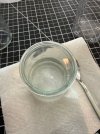
Smashing it seems pretty involved after trying this.
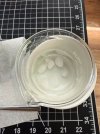
I tried heating the water in the microwave with a new batch of 40g / 1.5 oz (in saltwater) and it seems to slightly accelerate the process. This is how it looks like after 10 minutes:

Magnetic stirrer?Thank you, yes, let it dissolve in saltwater. Two rocks (12 gram/0.5 oz) added into room temp saltwater, still shows this much left after 90 minutes.
View attachment 78669
Smashing it seems pretty involved after trying this.
I tried heating the water in the microwave with a new batch of 40g / 1.5 oz (in saltwater) and it seems to slightly accelerate the process. This is how it looks like after 10 minutes:
View attachment 78670
Left Picture is the stirrer plate, right is the little magent that spins the liquid around.
(Most plates come with at least one of those)
Glass breaker actually optional though I bought a set of multiple sizes pretty cheap. As long as container isn't much bigger than plate and thin enough for the magnets to be able to reach each other to spin making the vortex.
I use these to mix all for reef. Turn it on medium come back in a hour or two it should be fully dissolved if it takes that long?
A whole legitimate set up could be put together for $40 or less. It's not used daily but useful to have in the hobby.
Alexander1312
Supporting Member
I have various sized magnetic stirrers but I feel they are only useful for fine powdered solution, including two/three part dosing, but not for these brick type potassium chloride blocks.Magnetic stirrer?
View attachment 78671
Left Picture is the stirrer plate, right is the little magent that spins the liquid around.
(Most plates come with at least one of those)
Glass breaker actually optional though I bought a set of multiple sizes pretty cheap. As long as container isn't much bigger than plate and thin enough for the magnets to be able to reach each other to spin making the vortex.
I use these to mix all for reef. Turn it on medium come back in a hour or two it should be fully dissolved if it takes that long?
A whole legitimate set up could be put together for $40 or less. It's not used daily but useful to have in the hobby.
Just think it could help verse stitting it in still water or shaking it like crazy lol.I have various sized magnetic stirrers but I feel they are only useful for fine powdered solution, including two/three part dosing, but not for these brick type potassium chloride blocks.
Alexander1312
Supporting Member
Pre-made KCI solution
Since it takes so long for it to dissolve [and which now disrupts my workflow today quite a bit], I am thinking now of premixing a solution for future immediate use.
The current solution Reef Bum recommends in 0.3% of KCI for dipping [2 teaspoon / 12g per gallon].
I want to keep a higher concentration in less water, which will depend on the saturation point for this element.
According to Gemini, the below shows the maximum % of KCI a solution can have - at a given temperature.
Creating a 20% solution seems to be a safe path to avoid precipitation.
If I use a 500 ml saltwater solution, I can add 100g of KCL into it, which would allow me to create a dip of up to 8 gallon [100g / 12g = approx 8 gallons].
Please let me know if you spot any error with this logic.

Since it takes so long for it to dissolve [and which now disrupts my workflow today quite a bit], I am thinking now of premixing a solution for future immediate use.
The current solution Reef Bum recommends in 0.3% of KCI for dipping [2 teaspoon / 12g per gallon].
I want to keep a higher concentration in less water, which will depend on the saturation point for this element.
According to Gemini, the below shows the maximum % of KCI a solution can have - at a given temperature.
Creating a 20% solution seems to be a safe path to avoid precipitation.
If I use a 500 ml saltwater solution, I can add 100g of KCL into it, which would allow me to create a dip of up to 8 gallon [100g / 12g = approx 8 gallons].
Please let me know if you spot any error with this logic.