

You are using an out of date browser. It may not display this or other websites correctly.
You should upgrade or use an alternative browser.
You should upgrade or use an alternative browser.
SFREEF3R'S Reefer 425XL
- Thread starter SFREEF3R
- Start date


Turkeysammich
Moderator
Looks Amazing in Person. Pics don’t do it justice. For you guys that don’t know. Erik is the person that donated the corals that I gave away on the last round of freebies.

Kensington Reefer
Supporting Member
Wowzers!
My compliments to the chef
My compliments to the chef
It's been a rough beginning of 2026! After several years without incident my number finally came up.
I was traveling for most of the month of January and while I was gone my Alk dosing head went bad, where it was only intermittently dosing Alk (the cylinders were slipping and not pinching the tube when the motor ran) . This caused a precipitous drop in my alk despite raising the dosing amount higher and higher on the controller side. It wasn't until I got home that I realized what was going on. At around the same time my KH director went out of whack and started reporting erroneous values. Between the two events I ended up rapidly overshooting my Alk without realizing it after the dramatic drop. Normally around 7.5, dropping to 6 and then shooting up closer to 9.
Needless to say many corals were not happy. 3 colonies RTN'd right off the bat and I saw a little recession in a few other corals. I got everything recalibrated, replaced the doser head, and alk stabilized - but over the course of the following week the two colonies were decimated.
My nutrients have historically been nearly undetectable which, while stable for years, I think didn't leave me a lot of margin for error as well. As growth slowed my alk consumption went down dramatically, but my nutrients climbed. Seemingly overnight, bryopsis exploded on one of the skeletons that was ravaged by RTN - I suspect catalyzed by the suddenly higher nutrients.
I didn't even know I had bryopsis in the tank! It wasn't a huge amount in the grand scheme of things but I knew I wanted to tackle it before it got out of hand. It was almost impossible to manually remove from the acro skeleton it was clinging to. I treated with fluconazole which was super effective at eliminating the bryopsis.
Unfortunately, I think as the consequence of the bryopsis die off, there was an accumulation of organic debris in my sump. On my next water change I stirred up a larger than usual cloud of detritus that caused a bacteria bloom. It only lasted a few days, but the presence of the bacteria or blocking of light (or both) dramatically reduced my alk consumption. My alerts on my controller failed and I didn't realize alk had shot back up again over 9 until it was too late. I slowly brought my Alk back down to my ~7.5 baseline but over the course of the following weeks I had a three more colonies deteriorate and nearly completely waste away. Pretty much every colony lost tissue in the areas that were shaded - I suspect that with the repeated stress those areas just didn't have the reserves to hang on.
Things seem to be pretty stable now but there is a bit of STN that I am tracking. I haven't technically lost any colonies yet entirely - all have at least a few polyps left, but it remains to be seen if the hardest hit ones will recover or not. Some like my ASD pink table only have a few clusters of few polyps each remaining. Fingers crossed things continue positively with stable parameters.
FTS today:
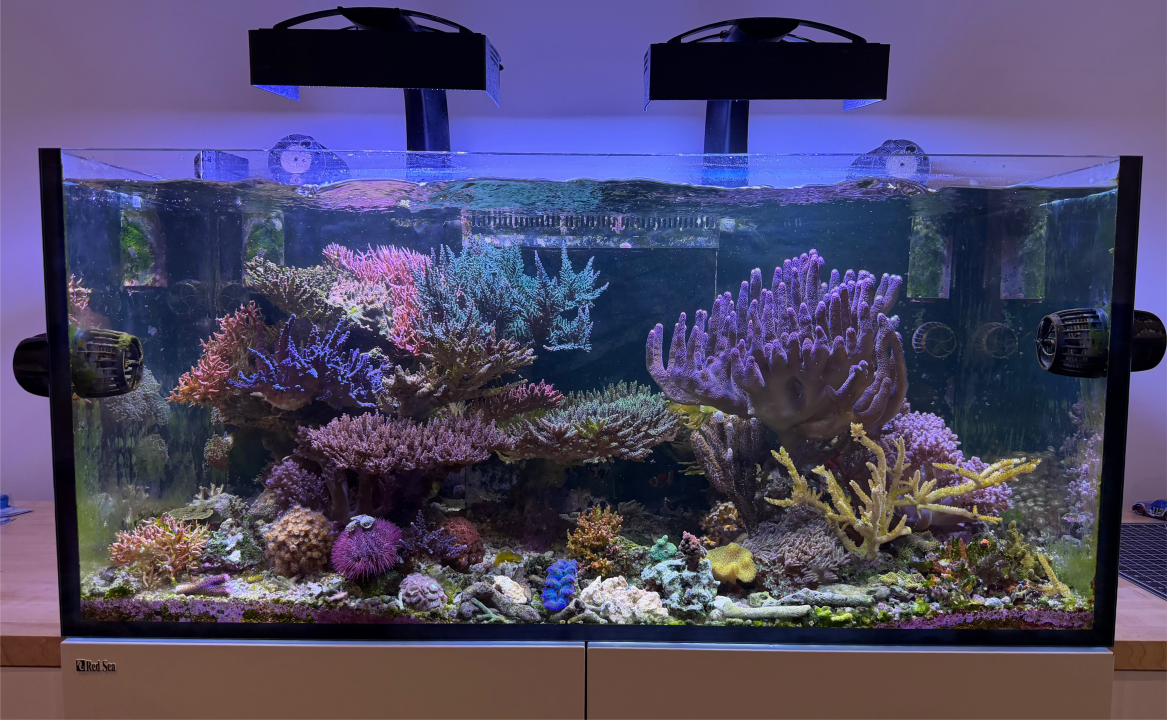
Labeling some of the colonies and calling out some of the hardest hit:
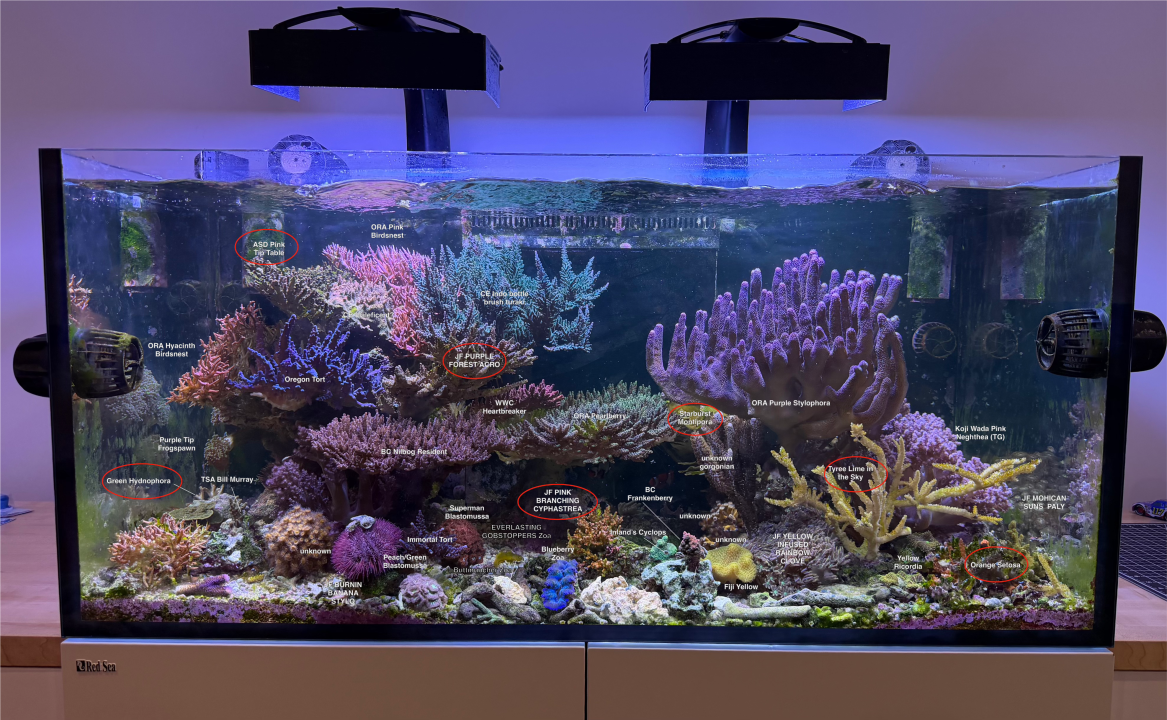
ASD Pink Tip Table - hardest hit, just a few pockets of a few polyps each remaining
Starburst Montipora - This was HUGE but hard to see because it's in the background. Near total loss, just a few patches in the more shadowed areas show tissue.
JF Purple forest acro - >90% loss but still several small "frag size" patches
Tyree Lime in the Sky - >90% loss. There is one branch that was in the shadows that held on. Interestingly there are half dozen or so single polyps scattered on the other branches that seem to be hanging on.
Orange Setosa - rapidly lost >80% but seems to be stabilizing
Green Hydnophora - >80% loss - this went out very quickly in the first round, was pretty surprised that it fell out before so many acros
JF Pink Branching Cyphastrea - in the second round lost 80-90% overnight with all the tissue not directly over a polyp disintegrating. Interestingly, over the past couple weeks it has rapidly recovered. Now at ~60% coverage.
The ORA pearlberry in the center, is my biggest concern right now. It lost around 20% (pretty much everywhere shaded by the WWC heartbreaker) but has a dozen or so very small regions of STN I am watching. I'm hoping it stabilizes but this is the main coral I'm watching.
Pretty much every coral showed some effects with big die off in my birds nests as well in shadowed areas. Minor die off in my Oregon tort in shadowed areas as well. It's interesting that some corals died off specifically in the low light areas vs. a handful only survived in the low light areas.
Of my larger colonies only the big Purple Stylophora, Indo bottle brush turaki, and CE Nilbog resident made it through more or less unscathed.
I was traveling for most of the month of January and while I was gone my Alk dosing head went bad, where it was only intermittently dosing Alk (the cylinders were slipping and not pinching the tube when the motor ran) . This caused a precipitous drop in my alk despite raising the dosing amount higher and higher on the controller side. It wasn't until I got home that I realized what was going on. At around the same time my KH director went out of whack and started reporting erroneous values. Between the two events I ended up rapidly overshooting my Alk without realizing it after the dramatic drop. Normally around 7.5, dropping to 6 and then shooting up closer to 9.
Needless to say many corals were not happy. 3 colonies RTN'd right off the bat and I saw a little recession in a few other corals. I got everything recalibrated, replaced the doser head, and alk stabilized - but over the course of the following week the two colonies were decimated.
My nutrients have historically been nearly undetectable which, while stable for years, I think didn't leave me a lot of margin for error as well. As growth slowed my alk consumption went down dramatically, but my nutrients climbed. Seemingly overnight, bryopsis exploded on one of the skeletons that was ravaged by RTN - I suspect catalyzed by the suddenly higher nutrients.
I didn't even know I had bryopsis in the tank! It wasn't a huge amount in the grand scheme of things but I knew I wanted to tackle it before it got out of hand. It was almost impossible to manually remove from the acro skeleton it was clinging to. I treated with fluconazole which was super effective at eliminating the bryopsis.
Unfortunately, I think as the consequence of the bryopsis die off, there was an accumulation of organic debris in my sump. On my next water change I stirred up a larger than usual cloud of detritus that caused a bacteria bloom. It only lasted a few days, but the presence of the bacteria or blocking of light (or both) dramatically reduced my alk consumption. My alerts on my controller failed and I didn't realize alk had shot back up again over 9 until it was too late. I slowly brought my Alk back down to my ~7.5 baseline but over the course of the following weeks I had a three more colonies deteriorate and nearly completely waste away. Pretty much every colony lost tissue in the areas that were shaded - I suspect that with the repeated stress those areas just didn't have the reserves to hang on.
Things seem to be pretty stable now but there is a bit of STN that I am tracking. I haven't technically lost any colonies yet entirely - all have at least a few polyps left, but it remains to be seen if the hardest hit ones will recover or not. Some like my ASD pink table only have a few clusters of few polyps each remaining. Fingers crossed things continue positively with stable parameters.
FTS today:
Labeling some of the colonies and calling out some of the hardest hit:
ASD Pink Tip Table - hardest hit, just a few pockets of a few polyps each remaining
Starburst Montipora - This was HUGE but hard to see because it's in the background. Near total loss, just a few patches in the more shadowed areas show tissue.
JF Purple forest acro - >90% loss but still several small "frag size" patches
Tyree Lime in the Sky - >90% loss. There is one branch that was in the shadows that held on. Interestingly there are half dozen or so single polyps scattered on the other branches that seem to be hanging on.
Orange Setosa - rapidly lost >80% but seems to be stabilizing
Green Hydnophora - >80% loss - this went out very quickly in the first round, was pretty surprised that it fell out before so many acros
JF Pink Branching Cyphastrea - in the second round lost 80-90% overnight with all the tissue not directly over a polyp disintegrating. Interestingly, over the past couple weeks it has rapidly recovered. Now at ~60% coverage.
The ORA pearlberry in the center, is my biggest concern right now. It lost around 20% (pretty much everywhere shaded by the WWC heartbreaker) but has a dozen or so very small regions of STN I am watching. I'm hoping it stabilizes but this is the main coral I'm watching.
Pretty much every coral showed some effects with big die off in my birds nests as well in shadowed areas. Minor die off in my Oregon tort in shadowed areas as well. It's interesting that some corals died off specifically in the low light areas vs. a handful only survived in the low light areas.
Of my larger colonies only the big Purple Stylophora, Indo bottle brush turaki, and CE Nilbog resident made it through more or less unscathed.
Last edited:
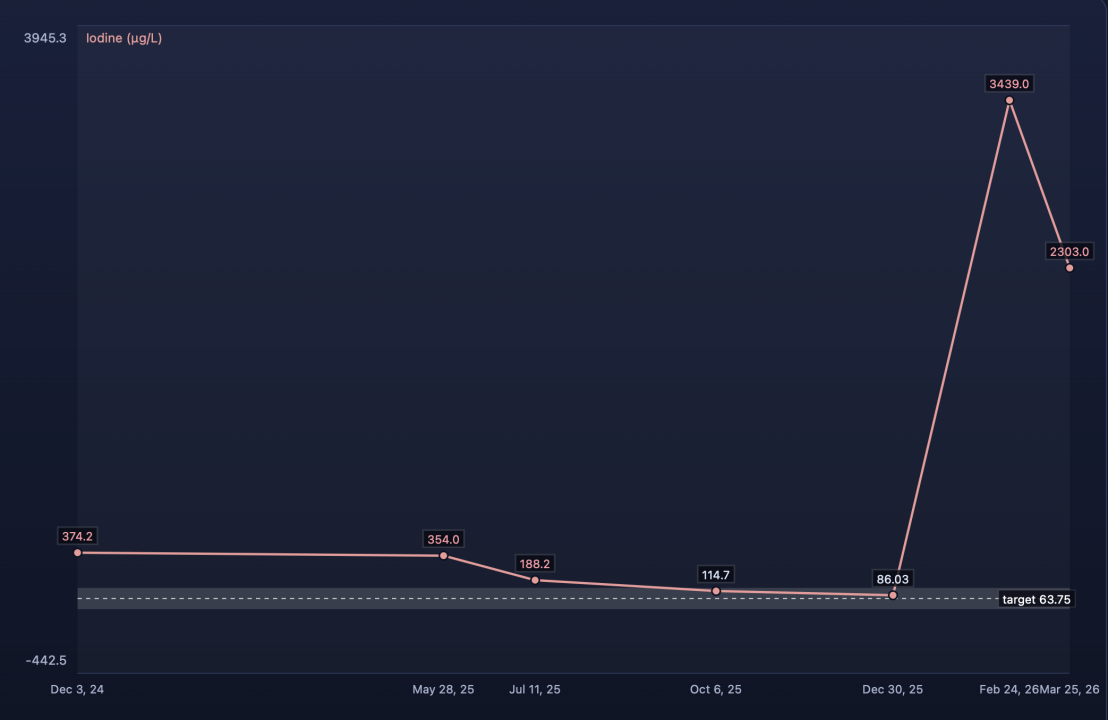
One other detail I totally forgot to include - one bizarre finding is that my iodine is off the charts!
Historically it's been elevated, but bizarrely jumped up. I sent out for ICP when I got back from my trip in January and the initial bout of die off happened. It was so high I thought it was an error. Nothing has changed in my additives, food, etc that could explain this.
But I just got back my next round of ICP from the end of March and it is also showing very high Iodine. Seems undeniable that something is amiss. I'm pretty sure the rapid Alk changes are most responsible for the die off because timing wise it is so closely related, but I do wonder if the elevated iodine is stressing my system. I added some carbon and have increased water changes slightly to try to gradually bring down.
Historically it's been elevated, but bizarrely jumped up. I sent out for ICP when I got back from my trip in January and the initial bout of die off happened. It was so high I thought it was an error. Nothing has changed in my additives, food, etc that could explain this.
But I just got back my next round of ICP from the end of March and it is also showing very high Iodine. Seems undeniable that something is amiss. I'm pretty sure the rapid Alk changes are most responsible for the die off because timing wise it is so closely related, but I do wonder if the elevated iodine is stressing my system. I added some carbon and have increased water changes slightly to try to gradually bring down.
Turkeysammich
Moderator
Daymn Bro. If you Need coral ? Just come by. I got some for ya.
Last edited:

Alexander1312
Supporting Member
Sorry about the issues you had. Failing equipment when you are out of town feels very unfair, but apparently a very common problem. I always worry about this.One other detail I totally forgot to include - one bizarre finding is that my iodine is off the charts!
Historically it's been elevated, but bizarrely jumped up. I sent out for ICP when I got back from my trip in January and the initial bout of die off happened. It was so high I thought it was an error. Nothing has changed in my additives, food, etc that could explain this.
But I just got back my next round of ICP from the end of March and it is also showing very high Iodine. Seems undeniable that something is amiss. I'm pretty sure the rapid Alk changes are most responsible for the die off because timing wise it is so closely related, but I do wonder if the elevated iodine is stressing my system. I added some carbon and have increased water changes slightly to try to gradually bring down.
View attachment 78813
The iodine is crazy high, even though it is only ug/L., so ‘only’ 2.3 mg//L. Carbon is the right way to go as you did.
Very interesting problem. High iodine normally leads to increased algae growth but these values are super high, so not sure if there is an additional escalation level at these amounts.
If high iodine leads to increased algae growth, a large algae die off could release a lot of iodine, potentially? Have not heard others showing this after die offs.
I am curious how you normally get iodine in your tank? What dosing do you do? No other parameters are shown as that much elevated on the ICP?

Btw -
Thanks! I may take you up on that. I’ve also been itching to do a coral order but wasn’t really sure where I would put new frags. Some real estate just opened up haha.Daymn Bro. If you Need coral ? Just come by. I got some for ya.
@Alexander1312 - I don’t specifically dose iodine though it is captured in my normal dosing routine. I dose Tropic Marin Part C to balance out my 2-part dosing. I also add to my part C 16ml/gallon of A-/K+. This is I think a pretty low dosage but Iodine is included in the A-.
The algae theory is interesting. Though the initial spike actually preceded the fluconazole treatment.
I did some searching and while there are other folks out there that have experienced the same shockingly high Iodine I couldn’t find any that were definitively root caused. I’m just hoping my attempts to being the chemistry back in line don’t cause some other problem.
I’m actually seeing some whitening of the edges of my Setosa which was one of the more sensitive coral in the last round. I’m suspecting my reduced feeding, increased WC frequency, and carbon may be causing too rapid a shift in something for its liking. Need to do some more exhaustive testing today. Alk fortunately has been rock solid.
The algae theory is interesting. Though the initial spike actually preceded the fluconazole treatment.
I did some searching and while there are other folks out there that have experienced the same shockingly high Iodine I couldn’t find any that were definitively root caused. I’m just hoping my attempts to being the chemistry back in line don’t cause some other problem.
I’m actually seeing some whitening of the edges of my Setosa which was one of the more sensitive coral in the last round. I’m suspecting my reduced feeding, increased WC frequency, and carbon may be causing too rapid a shift in something for its liking. Need to do some more exhaustive testing today. Alk fortunately has been rock solid.
Sorry about the issues you had. Failing equipment when you are out of town feels very unfair, but apparently a very common problem. I always worry about this.
The iodine is crazy high, even though it is only ug/L., so ‘only’ 2.3 mg//L. Carbon is the right way to go as you did.
Very interesting problem. High iodine normally leads to increased algae growth but these values are super high, so not sure if there is an additional escalation level at these amounts.
If high iodine leads to increased algae growth, a large algae die off could release a lot of iodine, potentially? Have not heard others showing this after die offs.
I am curious how you normally get iodine in your tank? What dosing do you do? No other parameters are shown as that much elevated on the ICP?
Last edited:
Thank you! Nilbog looks solid but if the Pearlberry deteriorates I may take you up on that.I still have a bc nilbog. If yours doesn't pull through. I have a Pearl berry as well and I could frag for you.
Just let me know before the swap if your going. Or tell me who to give it to near you if your aren't.Thank you! Nilbog looks solid but if the Pearlberry deteriorates I may take you up on that.